Five Keys to Contract Monitoring – and How to Make Them Work
Better tendering strengthens competition and helps secure initial value. However, in public procurement, true value is realised over the life of the contract. Robust contract management and monitoring are essential to protect outcomes, ensure compliance, and safeguard public funds.
Discover the five essential keys to contract monitoring – and how to implement them with Mercell Tendering.

Digitalisation alone does not equal control. Most buyers (74%) now use contract management tools, meaning contracts are increasingly stored digitally rather than in folders or email. However, contract tools are still often treated as a repository rather than an active management system: 53% of buyers either lack tools that enable dynamic contract follow-ups, or they have them but don’t use them in practice.
When the contracts get stored across shared drives, inboxes, and spreadsheets, obligations are easily overlooked. Key dates are missed. Invoice checks become routine approvals. Supplier performance issues are handled informally, without documentation. And by the time problems become visible, the organisation has already paid the price – financially, operationally, and sometimes legally.
ProcurFinland’s answer to the post-award blind spot
Five Keys to Contract Monitoring guide*, published by ProcurFinland as part of a Ministry of Finance initiative, makes the risk of this post-award blind spot clear.
The guide is written for public-sector professionals responsible for contract implementation, particularly contract managers. The purpose is to ensure that contracting authorities receive exactly what has been agreed and paid for, and that contract performance is monitored, documented, and managed throughout the contract period.
The key here is that public procurement does not succeed at award. It succeeds during delivery. In this article, you will learn how to bridge the gap between theoretical guidance and practical execution.
Substantial financial and operational benefits can be achieved during the contract period when the contract is actively monitored and complied with.”
* In 2024, the Finnish Ministry of Finance appointed Procurement Finland to strengthen the impact and sustainability of public procurement through the Programme for Impactful Public Procurement. As part of this work, the guide Five Keys to Contract Monitoring was published to support contracting authorities operating under the Finnish Public Procurement Act (1397/2016), with applicability also to other regulated procurement areas. The guide applies broadly to goods, services and works contracts. Read it here.
Why contract monitoring fails after tender award
The risk of poor contract delivery is not only inefficiency. The risk is losing control of taxpayers’ money, supplier accountability, and legal defensibility, while still appearing “compliant” on paper.
Common operational weakness often escalate into serious problems:
- Missed option and expiry dates → rushed renewals or last-minute re-tenders
- Paying incorrect invoices → financial leakage and loss of public funds
- Inability to enforce contract terms → quality drift and poor delivery
- Weak complaint trail → inability to terminate or exclude suppliers later
- Off-contract buying → fragmentation and reduced cost-effectiveness
- Unclear ownership → governance failure, especially during personnel changes
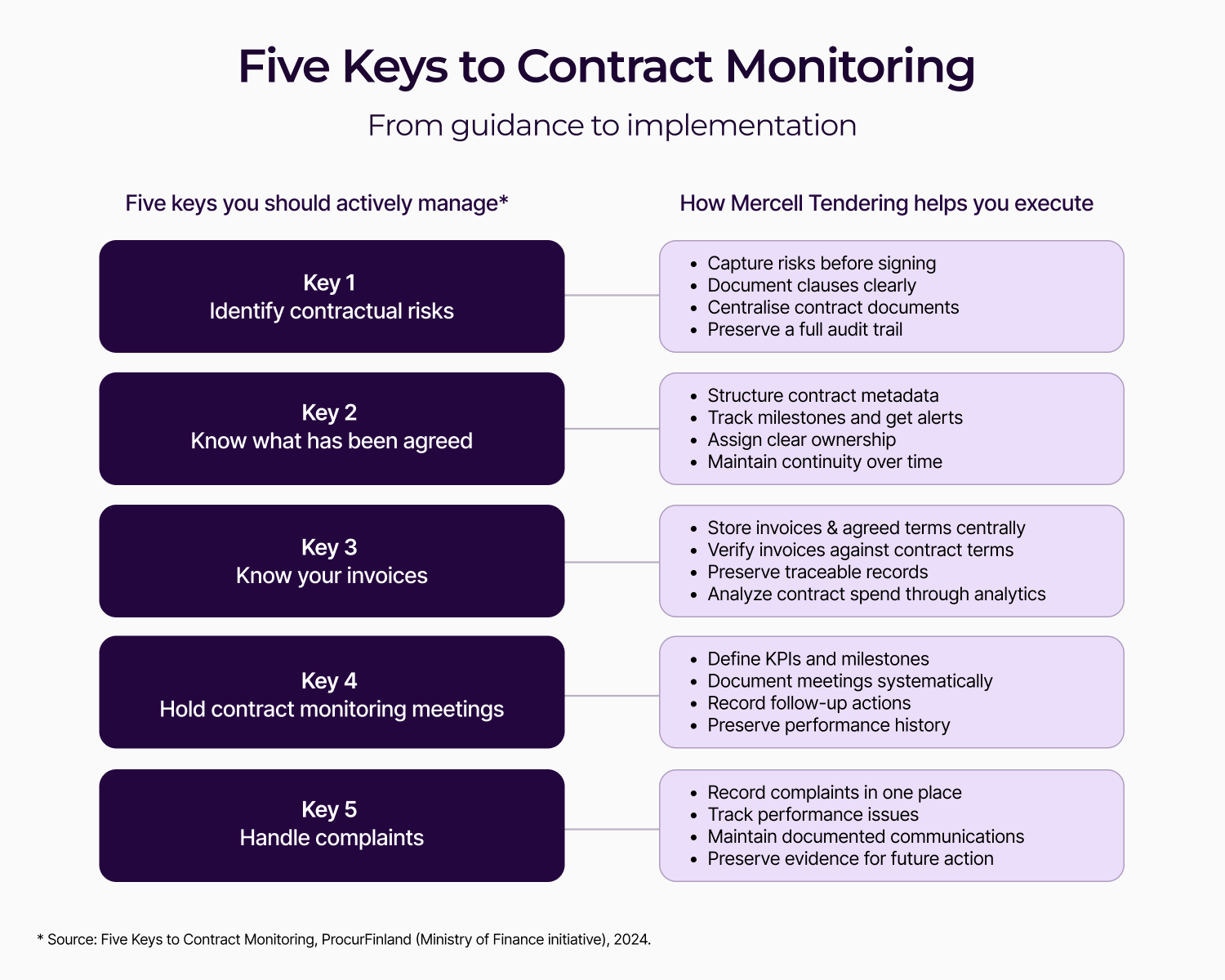
To avoid these challenges, the guide responds with a practical framework: Five Keys to Contract Monitoring. These keys describe what public buyers must actively do to protect value throughout the contract lifecycle. The question is how to translate these recommendations into daily practice.
Reach out to learn more or keep reading the article.
Five Keys to Contract Monitoring in public procurement – from guideline to execution
Key 1: Identify contractual risks
Effective contract monitoring begins before the contract is signed. The guide emphasises that contract-specific risks and potential change situations should be identified during procurement preparation, and that clear, precise modification and option clauses must be included in the tender documents if flexibility is to be allowed during the contract period. Risk allocation should be assessed realistically, including through market dialogue, so that change situations can be managed through predefined contractual mechanisms rather than improvised solutions.
What usually goes wrong
Risks and change needs are only addressed once they arise. Without clearly defined clauses in place, contracting authorities may lack structured mechanisms to manage changes during execution.
How you can put this into practice with Mercell Tendering
Mercell Tendering helps you prepare procurements early, structure tender documentation, and conduct market dialogue to identify realistic risks, cost impacts, and potential change scenarios before contract signing.
After award, the priority shifts to ensuring that those risk allocations and modification clauses remain visible and traceable throughout the contract period, even as responsibilities shift. Mercell enables you to:
- Record contract-specific risks right from the start at planning stage, through to tendering and before contract signing
- Maintain a structured contract record with key obligations and risk-related clauses
- Centralise all contract documentation in one secure repository, so the latest version is always accessible
- Preserve a full audit trail, ensuring decisions and changes remain traceable over time
Key 2: Know what has been agreed
Contract monitoring requires clear visibility of what has been agreed. The guide emphasises that contracts should be stored electronically in an accessible location, with key metadata recorded – including supplier details, contract value, validity period, expiry dates, notice periods, option exercise deadlines, and the responsible contract manager. Each contract should have a designated contract manager who understands the contractual mechanisms, monitors implementation and financial use, and ensures the organisation uses the contract correctly.
What usually goes wrong
Contracts are stored inconsistently. Key dates are not visible. Responsibilities shift during personnel changes. Oversight becomes fragmented.
How you can put this into practice with Mercell Tendering
To manage contracts consistently across teams, you need a shared system that makes contract terms, key dates, and responsibilities accessible and clear – not dependent on individual knowledge or scattered storage. Mercell enables you to:
- Centralise all contracts and metadata in a single source of truth
- Track contract milestones, tasks, and receive alerts such as expiry dates and option deadlines with structured lifecycle visibility
- Assign and manage ownership through role-based workflows
- Ensure version control and continuity across personnel changes
Key 3: Know your invoices
Invoice review is a central part of responsible contract monitoring. The guide states that invoices must not simply be approved; the contracting authority must verify that a valid contract exists, that the contractual performance has been delivered, and that invoice details, including pricing, itemisation, and any additional charges, correspond to what has been agreed in the tender documents and signed contract. Incorrect invoices must be returned with a clear request for correction.
What usually goes wrong
Invoice approval becomes routine. Minor discrepancies may repeat over time, particularly in complex service contracts with multiple pricing mechanisms.
How you can put this into practice with Mercell Tendering
Invoice verification becomes significantly more reliable when contract terms, pricing documentation, and supporting records are easy to access and consistently stored in one place. Mercell supports this by ensuring contract documentation remains centralised and traceable throughout the contract period. It enables you to:
- Access structured contract documentation and agreed terms in one place
- Store invoice-related documentation within the contract record, supporting verifiable follow-up
- Maintain documented traceability supporting accountability and audit readiness
For organisations that want stronger oversight of contract spend, Mercell data can also support procurement analytics by making contract, tender, and supplier information accessible for reporting in external BI tools such as PowerBI.
Key 4: Hold contract monitoring meetings
Structured follow-up is essential during the contract period. The guide states that contract managers are responsible for organising regular monitoring meetings, at least annually for all contracts, and that minutes should be documented and stored with the contract. Monitoring meetings should review performance, agreed indicators, and areas for improvement, and support constructive dialogue and partnership throughout the contract period.
What usually goes wrong
Monitoring is reactive and undocumented. Feedback is inconsistent. Knowledge is lost when personnel change roles.
How you can put this into practice with Mercell Tendering
The key is making contract monitoring repeatable – ensuring meeting documentation, follow-up actions, and performance discussions are recorded and accessible across the contract lifecycle. Mercell enables you to:
- Set contract-level and supplier-level milestones and KPIs to support structured follow-up
- Store meeting documentation within the contract record
- Preserve documented history of discussions and agreed actions
Key 5: Handle complaints
The guide emphasises that non-compliant conduct must be addressed without delay. Complaints should be documented in a verifiable manner when necessary, particularly in situations that may lead to termination or exclusion due to poor performance. Written complaints should clearly describe the deviation, specify required corrective measures and timeframes, and be stored systematically so that deficiencies can be demonstrably proven in future proceedings or tendering procedures.
What usually goes wrong
Issues are handled informally or too late. Complaints are not systematically recorded, leaving the contracting authority without sufficient evidence when escalation becomes necessary.
How you can put this into practice with Mercell Tendering
To manage supplier performance issues effectively, documentation must be centralised and traceable so that complaints and corrective actions remain accessible over time and across personnel changes. Mercell enables you to:
- Centralise complaint documentation within the contract record
- Preserve audit trails of performance issues and communications
- Ensure visibility beyond individual inboxes or isolated files
Conclusion: Make every contract count
ProcurFinland’s Five Keys to Contract Monitoring make a clear point: strong procurement governance depends on structured follow-up during the contract period. Visibility, ownership, documentation, and timely action are not optional – they are prerequisites for protecting taxpayers’ money and ensuring delivery.
The difficulty is not understanding these principles. It is applying them consistently across contracts, teams, and years.
Mercell Tendering supports this by connecting the full procurement lifecycle, from early planning and market dialogue through tender execution and into structured contract follow-up. It helps contracting authorities build stronger contracts upfront, preserve continuity after award, and maintain the documentation and traceability needed to manage supplier performance, control invoicing, and act confidently when issues arise. Instead of contract monitoring depending on individual discipline or fragmented tools, Mercell makes it repeatable across contracts, teams, and years.
In public procurement, performance is not secured by signing a contract. It is secured by managing it systematically.
See how Mercell helps you operationalise Five Keys
Book a short demo to explore how structured contract follow-up, documentation, and lifecycle control can be built into your daily procurement work.